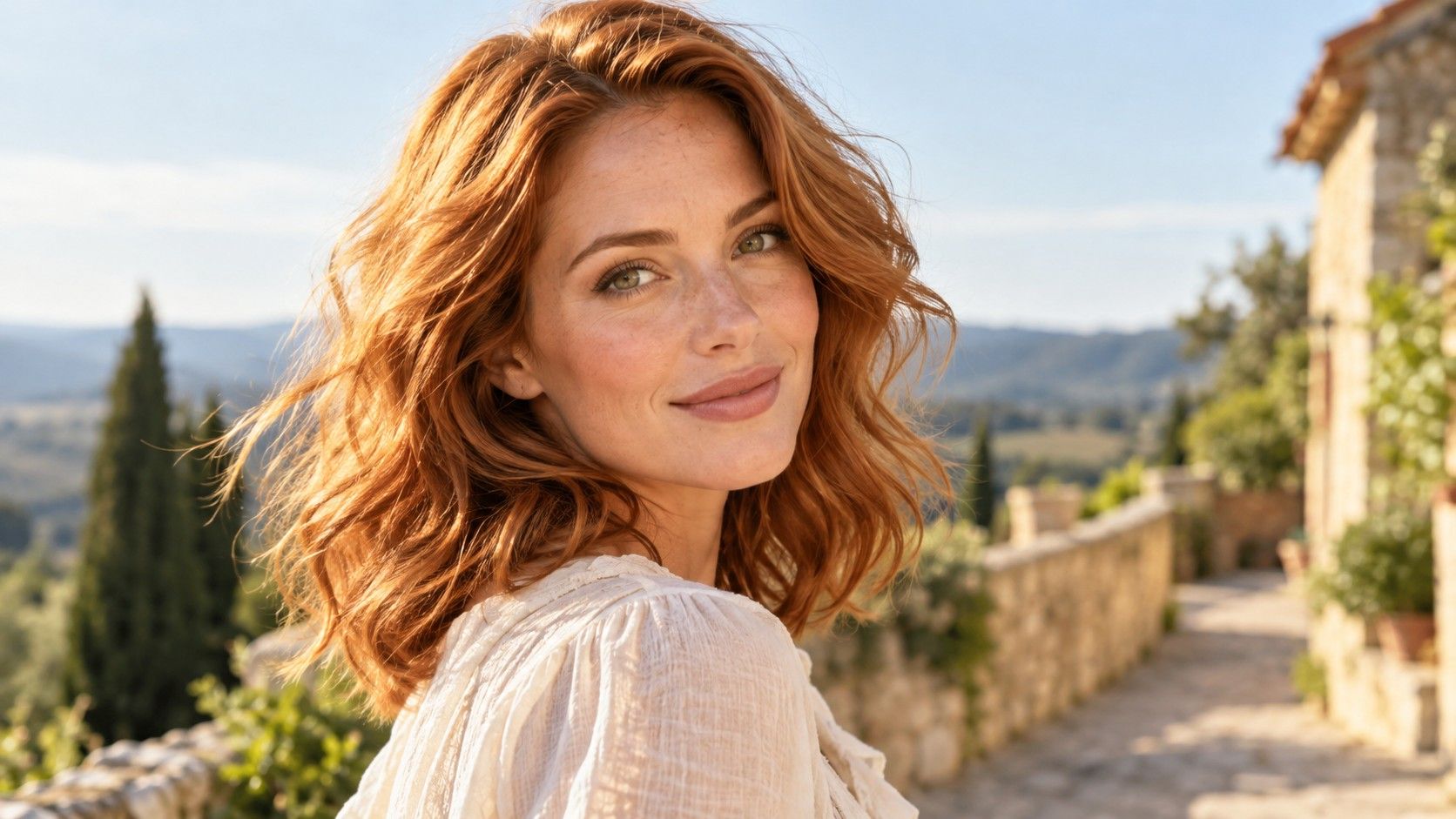
Soft summer auburn hair is a slightly awkward pairing on a color chart: Soft Summer palettes usually favor muted, cooler colors, while auburn carries red-brown warmth. That does not make the idea impossible. It means the useful question is how much red you want to see, and whether a subdued brown base gives you the result you enjoy.
When your favorite auburn sits outside your suggested palette
Seasonal color analysis is an optional way to organize styling choices, not a strict classification that grants or refuses permission to color your hair. Soft Summer generally points toward softened, relatively cool colors and lower contrast, but systems vary. You do not need to abandon an auburn reference because of a label. Use the label to ask better questions about saturation, warmth and depth.
Auburn is a broad name. It can mean brown with a quiet red reflection, a distinct copper-brown or a deeper wine-influenced shade. Those differences matter more than whether a caption calls the color suitable for a season. Pull three pictures at a similar depth and compare the brightest parts. Is the reflection orange, red or closer to a neutral brown? Which of those effects drew you to the picture?
Try to identify the part you would miss if it disappeared. You may want actual red hair, or you may be responding to the richness and shine of the brown base. If you prefer the reference once its red reflection is less visible, a neutral brunette could satisfy the original wish. If red is the entire attraction, keep it in the conversation and decide how deliberately you want to depart from a quiet palette.
Compare muted red-brown with bright copper at the same depth
Hold a brown-based auburn beside a brighter copper without changing the lightness very much. This is a cleaner comparison than putting a pale strawberry blonde against a dark red-brown, where depth and intensity change together. A muted auburn should read as a blend of brown and red rather than a pure flash of orange. The exact balance needs a swatch and a reference, since the names are not standardized.
Use indirect daylight for the first comparison and ordinary indoor light for the second. A subdued red-brown may appear mainly brunette indoors and more obviously red outside. Decide whether you enjoy that range. A photograph taken only under a warm salon lamp can make the warmth difficult to judge, while an edited image may exaggerate it. Look for multiple views of the same result when possible.
Keep the rest of the face fairly consistent during your test. Strong lipstick and a different brow shape can make two shades seem more or less harmonious for reasons unrelated to the hair. You do not have to give up makeup to assess color; simply compare with the makeup you normally wear. The goal is a result you enjoy on ordinary days, not one that depends on recreating the reference model’s entire look.
Keep the base near your natural depth if softness matters most
A large jump in darkness can make a muted color feel surprisingly dramatic. If your natural hair is light or medium brown, compare auburn references close to that depth before looking at deep mahogany. The deeper option may still be your favorite, but it brings a stronger frame around the face. That contrast is a separate choice from whether the red itself is gentle.
Look at your roots and brows together. A quiet red-brown close to your starting depth may leave those relationships fairly familiar, while a dark base can make light brows appear more noticeable. There is no automatic requirement to recolor brows or intensify makeup. Ask whether you like the new balance as it is. If not, adjust the hair shortlist before creating more changes you did not originally want.
For someone with highlighted lengths, maintaining softness may mean reducing the contrast between the brightest pieces and the base. It might also mean preserving some lightness so the overall result does not become too solid. These are different design choices. Bring a photo of the current distribution of light and dark areas and explain which ones you want to keep visible.
The cut and texture affect how a subdued shade reads. Smooth hair can show a broad reflection across the surface, while curls distribute light and shadow through many smaller areas. Compare references with a texture and styling routine reasonably close to yours. A polished, curled salon finish may contain more visible dimension than the same color worn in a simple straight style.
Separate copper warmth from burgundy and violet reflections
If orange copper is what bothers you, a red-brown with less obvious orange may feel more comfortable. That does not mean the next answer must be burgundy. A wine or violet influence creates another distinct color direction and can look much more deliberate than a subdued natural-looking auburn. Compare actual references rather than treating cooler red as a synonym for understated.
The word ash can cause confusion here too. Some people use it to mean less orange; others expect a visibly smoky or gray effect. Tell the colorist which reflection you want reduced and which you want to retain. Asking for both a clearly warm auburn and no warmth at all creates a contradiction that a color name cannot resolve. Brown with a restrained red reflection is a more specific starting description.
Include a plain neutral brown in the comparison even if you are leaning red. It acts as a useful baseline for judging how much difference the auburn really adds. If you like only a tiny increase in warmth, say that directly. A small shift can feel satisfying without pretending to be a complete red transformation, and it gives the colorist a clearer target than the broad instruction to make auburn work for Soft Summer.
Consider a limited placement before a full red-brown change
A few muted auburn pieces can test your appetite for warmth without putting it across the entire visible surface. Placement still matters: a red face frame changes the impression around your features, while warmer pieces underneath may show mostly with movement or an updo. Show the colorist how you normally part, tuck and tie your hair so the pattern works outside a single styled photograph.
A small placement is not automatically a low-maintenance service. If it requires lightening, or if your lengths already contain old dye, the work and later care may still be significant. Ask how the selected pieces will be achieved and what happens as the tone changes. You are choosing the size of the visual effect, which is only one part of the practical commitment.
If you already have naturally reddish areas, point them out in daylight. You may prefer to work with those existing differences rather than impose a completely new pattern. Conversely, previous highlights might make red appear stronger in certain sections than you expected. A professional can assess that starting point and decide whether testing a strand would help before the full appointment.
Be cautious about treating any color as a quick reversible experiment on very light or porous hair. A result that gradually fades can still leave a changed reflection. Explain if you expect to return to a particular blonde or cool brown later. Understanding that future route is more useful than assuming that the word subtle guarantees an easy undo.
Choose the version whose faded stage you can live with
Ask what the shade may look like after the fresh salon finish softens. A muted red-brown can change its balance between red and brown as it wears, and previously lightened pieces may behave differently from untouched areas. No exact timetable applies to everyone. Discuss your washing and styling habits and ask which change you are most likely to notice first on your particular hair.
Root contrast belongs in the same conversation. A shade close to your natural depth may grow out more quietly than a deep auburn or a much lighter red-brown, but visible gray changes the comparison. Decide whether you want coverage, blending or your silver left visible. Do not let the seasonal palette make that separate preference for you.
For the final consultation, bring one brown-based auburn you like, one neutral brown for comparison and one red you would consider too intense. Describe the depth, the amount of red in daylight and the root transition you want. Add an unfiltered current photograph and a truthful color history. The colorist can then assess a concrete result rather than trying to reconcile two broad labels.
You do not have to prove that auburn belongs in a Soft Summer chart. A seasonal framework earns its place only when it helps you see a useful distinction. If muted auburn gives you the small red shift you wanted, that is enough; if the quieter brown wins the comparison, it is an equally complete decision.